

Carnet de voyageOctober 2026
BordeauxThree days
inside the legend
Four travellers. Two banks. A journey into the heart of wine.
Begin the journey↓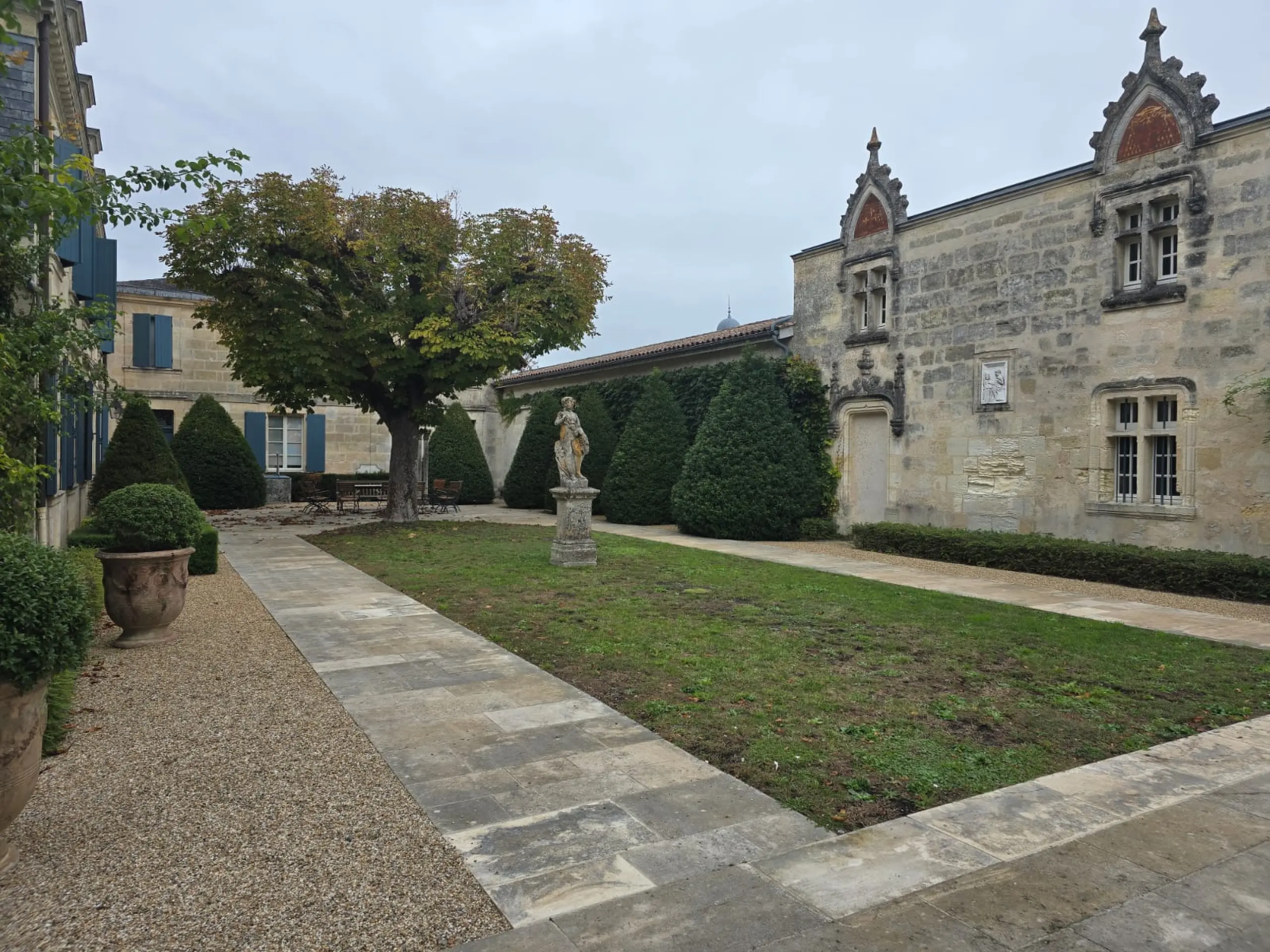
00 · Prologue
Some names have been with you all your life.
Then, one day, you walk through their gates.
On 19 October 2026 we leave Milan Malpensa. Our destination is Bordeaux, our base is Gradignan, and our first appointment is at 15:30: Château La Mission Haut-Brion. The journey begins with a name that belongs to the history of wine, but which, from this afternoon, will also have a face, a light and a precise place in our memory.
There are four of us, with different experiences and the same curiosity. Over three days we explore vineyards, courtyards, cellars and tasting rooms, travelling from the Left Bank to the Libournais. This journal follows our photographs, from the first images of our arrival to the glass, where the landscape becomes wine once more.
- Departure
- Milan Malpensa
- Arrival
- Bordeaux
- Base
- Gradignan · Hôtel Novalis
- First visit
- La Mission Haut-Brion · 15:30
Our travelling companions
Four perspectives,
one shared passion.
- 01Dante CerioliAIS Professional Sommelier
- 02Diego LucciniOwner of Osteria de l'Umbreleèr, a restaurant listed in the Michelin Guide
- 03Dr. Marco StabilePlastic surgeon and collector of fine wines
- 04Massimo GiovanniniA passionate and knowledgeable wine enthusiast
01 · The route
Three days.
Two banks.
First Pessac-Léognan, then the road through the great châteaux of the Médoc. On the third day our perspective changes: Pomerol and Saint-Émilion, on the Right Bank. Three days, three wine landscapes.
20 October
Médoc
Margaux · Palmer · Léoville Barton · Léoville PoyferréComing soon21 October
Libournais
Pomerol · Angélus · Saint-Émilion · Beauséjour Duffau-LagarrosseComing soon19 October · The first moments
Crossing
the threshold.
The gate, the vineyard, our first encounter with La Mission. Two short films open the visit and convey a sense of the place before we enter the courtyard.
The gate’s wrought iron anticipates the geometry of the estate: a threshold between the road and the quieter pace of the visit.
The gate and the vines
The entrance to the estate: where the journey becomes a visit.
A first glimpse of the vineyard
The vineyards of La Mission, before we move on to the historic buildings.
02 · Pessac-Léognan
Château
La Mission
Haut-Brion
A place where stone, silence and technical precision speak the same language.
A few kilometres from central Bordeaux, between Talence and Pessac, La Mission Haut-Brion looks towards neighbouring Haut-Brion. The two estates share the great gravel terrace of the Graves, while each retains its own identity.
1855 Classification
Château Haut-Brion
Premier Cru ClasséThe only château in the Graves included in the historic classification of great red wines.Graves Classification
Château La Mission Haut-Brion
Cru Classé de GravesIt belongs to the Graves Classification. Its international reputation accompanies this designation, which is distinct from the 1855 title of Premier Cru.Two different classifications, both essential to understanding Bordeaux’s historic hierarchy.
Notes on the land
The soil,
before the label.
The graves are pebbles and gravel, largely quartz-based, lying over a subsoil of clay, sand and limestone. The undulating terrain encourages drainage: the character of the place begins beneath the vines.
- Red varieties
- Merlot, Cabernet Sauvignon, Cabernet Franc
- White varieties
- Sémillon and Sauvignon Blanc
The estate’s vineyard
around 25 ha of red varieties and over 4 ha of white varieties
19 October · The courtyard
Our first close encounter.
The overall view gives way to details: the façade’s finials, stone windows, wrought-iron lantern and garden design. The second photograph adds the travellers’ presence to the geography of the place.
The memory of the place
Almost five centuries,
six defining moments.
The origins
Arnaud de Lestonnac acquires the first part of the future estate.
The Mission Fathers
The estate passes to the Lazarists, who develop the vineyard and the reputation of its wines.
The chapel
Notre-Dame d’Aubrion is built and consecrated, becoming the estate’s spiritual landmark.
The Woltner family
Frédéric Otto Woltner acquires La Mission and begins a new technical era.
The Dillon family
Domaine Clarence Dillon acquires La Mission, historically linked to neighbouring Haut-Brion.
New architecture
The Grand Chai, cloister, tasting room and new gardens are inaugurated.
03 · Stone and symbols
A cellar
with a soul.
The visit unfolds through contrasts: the precision of the garden, the coloured light of the chapel, the cross recurring on walls and floors, and the almost liturgical geometry of the barrels.
The landscape
An order that prepares the eye.
Before the cellar, the garden invites a pause. The lines of the hedges, the pools and the pale stone create a gradual transition from the vineyard to the working spaces.
The chapel · 1698
The light
of memory.
In the stained glass, blue, red and gold interrupt the restraint of the stone. The figures, decoration and light passing through them give the chapel an intimate scale, different from the monumental cellar.
The photographs bring together two visual languages: the intricate design of the glass and the simplicity of the walls. Figures and layered scenes emerge in the windows; inside, statues, dark wood and pale stone draw the eye back to the whole.
A recurring sign
From chapel to bottle.
The emblem accompanies us throughout the visit: carved in stone, set into floors, painted on walls and impressed in glass. A coherent visual identity, centuries before the language of branding.
04 · The Grand Chai
A cathedral
for wine.
The Grand Chai, inaugurated in 2009, uses stone from the Frontenac quarries. Columns, vaults and rows of barrels give the ageing process a monumental setting: the eye follows the floor, passes through the arches and disappears into the depth of the hall.
16:07—16:09 · Inside the chai
Architecture meets work.
From the raised walkway the eye crosses columns, a geometric floor and rows of barrels. A trolley between the barrels reminds us that this monumental space is, above all, a working cellar.
The measure of oak.
For La Mission’s red wine, the estate specifies 18–20 months of barrel ageing. The proportion of new oak varies with the vintage: the aim is to support the wine’s evolution while maintaining balance with its substance.
Traditional rackings à l’esquive separate the wine from its sediment. Behind the symmetry of the barrels lies this patient, repeated and precise work.
The estate’s savoir-faire ↗05 · The tasting
Two identities.
A dialogue in the glass.
La Clarté, the two second wines and the two grands vins: five labels connect La Mission Haut-Brion with neighbouring Haut-Brion. After the stone, the vines and the oak, the visit finds its focus here.
16:21 · The tasting room
From the silence of the chai
to conversation.
Blue walls, wood panelling and a geometric parquet floor change the pace of the visit. Paintings and bottles belong to an intimate setting, where attention moves from architecture to the table.
The estate’s official history recalls the work of Italian wood craftsmen and a collection of original Albrecht Dürer engravings in the tasting room. Art and craftsmanship add another dimension to the visit, alongside the memory of wine.
Inside the blue room
Blue wood panelling, framed pictures and bottles: a glimpse inside the room.
16:21—16:22 · The bottles on display
White and red,
the signature of La Mission.
Two bottles from the 2021 vintage are displayed with their presentation cases. The blanc tells the estate’s other story: a dry white wine closely associated with Sémillon, formerly known as Laville Haut-Brion. The rouge bears on its label the image of the estate we have just explored.
The tasting notebook
One white.
Two pairs of reds.
The five bottles tasted, grouped to make the comparison clear: the shared white wine, the second wines and the grands vins. All four reds are from 2017; La Clarté is from 2023.
Le blanc · Two estates
01La Clarté de Haut-Brion
2023A white wine bringing together grapes from Château Haut-Brion and Château La Mission Haut-Brion. It is the meeting point between the two estates: the name La Clarté expresses a shared identity alongside their respective white grands vins.La Mission · Second wine
02La Chapelle de La Mission Haut-Brion
2017La Mission’s second red wine takes its name from the chapel built by the Lazarists in 1698. Having walked through the chapel, seeing its name again on the label makes the bond between place and wine immediate.Haut-Brion · Second wine
03Le Clarence de Haut-Brion
2017Formerly known as Château Bahans Haut-Brion, it has borne Clarence Dillon’s name since the 2007 vintage. The estate presents it as a second wine expressing Haut-Brion’s style while reaching maturity sooner than the grand vin.La Mission · Grand vin
04Château La Mission Haut-Brion
2017A Cru Classé de Graves, this is the red wine of the estate welcoming us. The blend varies by vintage: the 2017 photographed on the table connects our visit to the chai with the wine that expresses its work.Haut-Brion · Grand vin
05Château Haut-Brion
2017An 1855 Premier Cru Classé, and the only château in the Graves included in the red-wine classification. Comparing it with La Mission in the same vintage, 2017, offers a valuable perspective: two neighbouring identities seen through the same year.The wine, finally in the glass
A glass of red wine, the bottle of Haut-Brion and our travelling companions: the final moments of the tasting.
16:39 · A final look
The place becomes
a memory.
The glass in the foreground, the bottle of Haut-Brion, the faces around the table. The film captures the most personal part of the visit: wine experienced together, in the place where it is made.
This is how La Mission stays in our memory: the light of the courtyard, the colours of the chapel, the depth of the chai and, finally, this conversation before we leave.
End of the first chapterThe journey continues
From the Médoc
to Saint-Émilion.
The second chapter will take us to Château Margaux, Palmer, Léoville Barton and Léoville Poyferré. The third will explore Pomerol and Saint-Émilion, continuing to Angélus and Beauséjour Duffau-Lagarrosse.
Back to Wine Geographies