

A private evening · A tasting reportage
BOLLINGERLa Grandeur
du Temps
Seven guests, a private dining room and three Bollinger formats. From the opening Sicilian toast to R.D. 1988 in Jeroboam, disgorged in 2003: the account of an evening that stays in the memory.
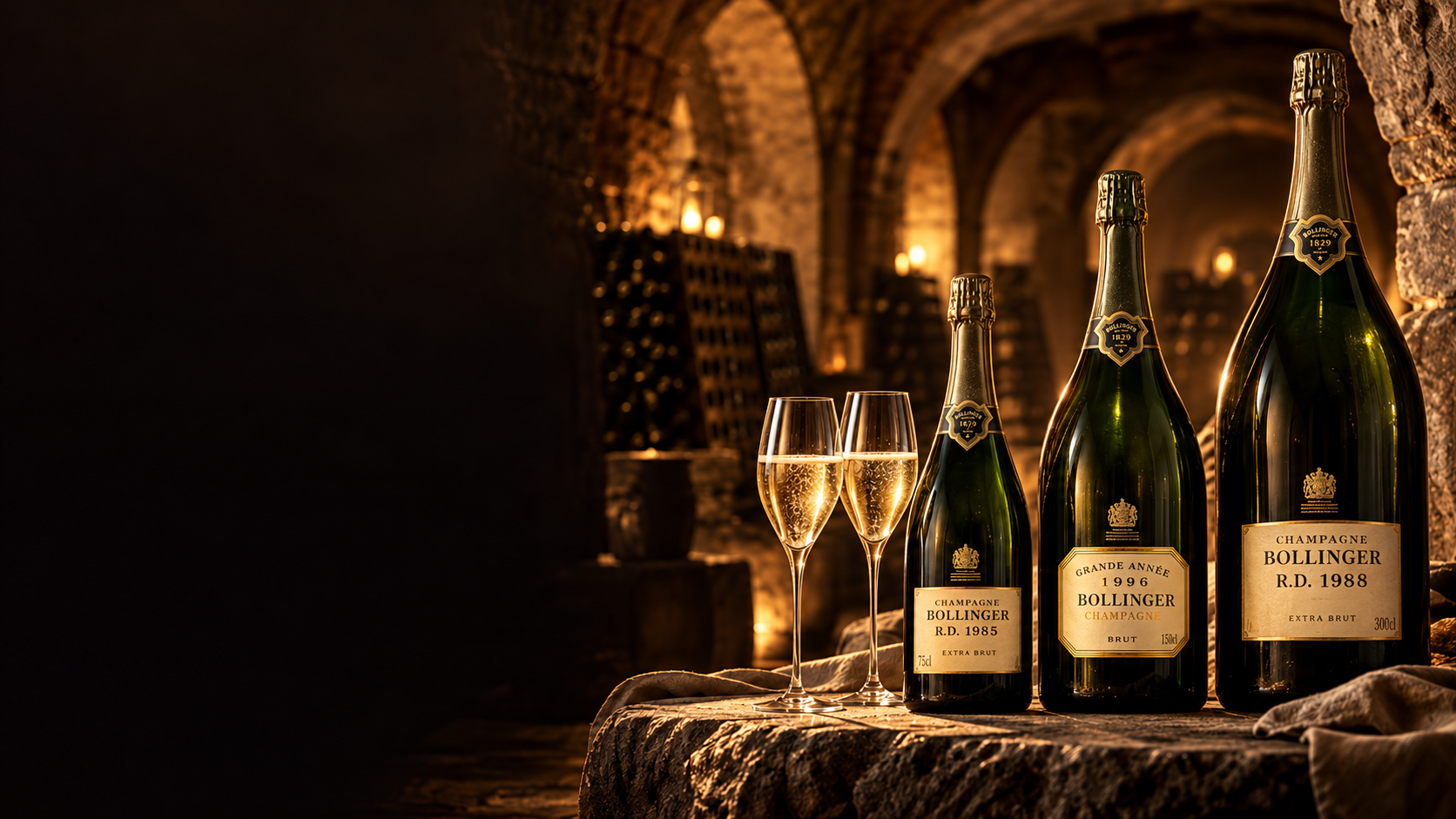
Enter the storyIllustrative cover · Labels reconstructed from the evening’s bottles
guests in a private room
Bollinger vintages · three formats
R.D. · Jeroboam · disgorged 2003
The moment
A private table. A memory for a lifetime.
On 9 October 2026 we dedicated the Osteria’s private room to seven guests. Alongside them were myself, Dante Cerioli, AIS Professional Sommelier, and Diego Luccini, owner of Osteria de l’Umbreleèr. An intimate table designed to give every bottle our full attention and share the pleasure of an exceptional tasting.
Among our guests we had the pleasure of welcoming Professor Guido Fanelli, Alberto Grua and our friend Antonio with his partner from Dubai. Different careers, friendship and curiosity met around the same table. The professional experience of some guests gave the conversation added depth; the heart of the evening remained the pleasure of being there together.
Service, wine and enjoyment required our full attention. We gathered the available photographs: faces, gestures, bottles and a few dishes. If other guests send us their pictures, we will add them to this account. A memorable evening for a small gathering, one we will find difficult to repeat with the same intensity.
Dante CerioliWith Diego Luccini · Owner of Osteria de l'Umbreleèr
Dante Cerioli with the five wines of the evening.
The table in the Osteria’s private dining room.
The sequence
The evening, glass by glass.
The sequence opened with Milazzo Riserva V38AG and Ancelin oysters. Next came André Beaufort, Ambonnay Grand Cru 1999, with sourdough toast, butter, sautéed porcini and white truffle.
The heart of the tasting followed three Bollinger chapters: R.D. 1985 in a 0.75-litre bottle, La Grande Année 1996 in a 1.5-litre Magnum and R.D. 1988 in a three-litre Jeroboam, disgorged in 2003. Vintages, formats and people gave the evening its character. The event’s title, La Grandeur du Temps, became a tangible story at our table.
The welcome
The first toast. The sea, on the plate.
Campobello di Licata, Sicily
Milazzo · Riserva V38AG
Chardonnay and Inzolia, base wines matured in steel and oak, and at least forty-eight months on the lees: this is how Milazzo’s official factsheet describes its Riserva V38AG Metodo Classico Brut. Our evening opened with this wine from Campobello di Licata and Ancelin oysters, a bright introduction before the Champagne vintages.
At the table
Ancelin oystersMaison Ancelin’s oyster-farming story spans Marennes-Oléron and Utah Beach in Normandy. Here the sea opens the tasting: the glass accompanies the oyster with restraint, leaving it at the centre of the first encounter.
The interlude
The interlude. A moment of autumn.
Ambonnay Grand Cru, Champagne
André Beaufort · 1999
Before the Bollinger trio we served André Beaufort, Ambonnay Grand Cru 1999. Ambonnay belongs to the Montagne de Reims and is one of the House’s two key origins, alongside Polisy. At our table the vintage accompanied sourdough toast with butter, sautéed porcini and white truffle.
At the table
Sourdough · butter · porcini · white truffleThe bread gives texture, the butter binds, and porcini and truffle bring woodland aromas. This was the pairing chosen for the evening: a meeting of texture, fragrance and time before the three Bollinger chapters.
The Bollinger trilogy
Three vintages. Three scales of time.
01 / 03 Bottle · 0.75 L
Bollinger R.D.1985
The opening of the trio.
The first Bollinger took us back to the 1985 harvest, forty-one years before our evening. The 0.75-litre bottle opened the comparison between vintages and formats. R.D. means Récemment Dégorgé: a name describing the House’s project of extending the wait on the lees and choosing disgorgement as a new point of departure.
The vintage remains the harvest year; disgorgement records a different stage in the Champagne’s life.
Bollinger R.D. 1985: the 0.75-litre bottle.
02 / 03 Magnum · 1.5 L
La Grande Année1996
Grandeur, in Magnum.
The 1996 arrived in a 1.5-litre Magnum: thirty years after harvest, another scale of service and another chapter of the tasting. La Grande Année is the House’s vintage cuvée, shaped by cru selection, old-barrel vinification and cellar maturation. For Dante, this bottle was spectacular, one of the evening’s great moments.
The photographed bottle retains its original 1996 label.
Dante presents La Grande Année 1996 in Magnum.
03 / 03 Jeroboam · 3 L
Bollinger R.D.1988
The wine that becomes a memory.
The trio culminated in R.D. 1988 in a three-litre Jeroboam, disgorged in 2003: thirty-eight years after harvest and twenty-three after that disgorgement at the time of the evening. A rare bottle personally sought out for this occasion. Here Dante’s account grows more intense: it recalled a meeting of Dom Pérignon P2 and Krug, a personal image expressing the magnitude of the experience.
1988: harvest. 2003: disgorgement of the bottle served that evening. Two dates, two chapters in the same story.
Dante with Bollinger R.D. 1988 in its 3-litre Jeroboam.
Dante serving the wines, with close attention to the table.
Sharing the wine: a moment during service.
Guests of honour
The people who made the evening.
The pleasure of welcoming Professor Guido Fanelli, whose academic career is linked to the University of Parma, and Alberto Grua, an executive with international leadership responsibilities. Together with our friend Antonio, his partner from Dubai and the other guests, their experience brought an added dimension to the evening’s conversation.
Professor Guido Fanelli with the Jeroboam of Bollinger R.D. 1988.
At the Osteria · 9 October 2026
Academia · Research · Public institutions
Professor Guido Fanelli
Former Full Professor of Anaesthesia and Intensive Care · University of Parma
- University of Parma
- San Raffaele
- Pain medicine
A career combining leadership of complex clinical services, the training of physicians and international institutional dialogue on pain care. Welcoming him to our table gave the evening the added value of a meeting between wine culture and a culture of care.
From San Raffaele to the University of Parma
Professor Guido Fanelli’s career has brought together anaesthesia, intensive care, pain research and specialist training. He graduated in Medicine and Surgery in Milan in 1983 and completed his specialist qualification in 1986. At San Raffaele, between 1997 and 2001, he coordinated the central multidisciplinary operating theatres and Acute Pain Service. In Parma he became director of the second Anaesthesia unit in 2002, a full professor in 2003 and director of the specialist training school in 2004.
Pain care: clinical and national responsibilities
In 2008 he was appointed coordinator of the ministerial commission on acute and chronic pain and palliative care. Hospital sources in 2015 identified him as head of the commission implementing Law 38. That year, the Parma centre he directed was presented as a regional reference facility, with six outpatient clinics, six beds and more than 16,000 clinical services annually. The hospital also documented pharmacogenomic research into back pain and advanced training in pain medicine.
Academia and personalised research
In 2015 Professor Fanelli chaired the Technical and Scientific Committee of BIOGENAP, a joint University of Parma and National Research Council project on bioelectronics, genomics and personalised nanomedicine in pain therapy. The university also identified him as the rector’s delegate for “Università senza dolore”. His academic profile brings together specialist teaching, interdisciplinary research and the organisation of care.
From Italian institutions to the United Nations
In March 2014 the University of Parma announced Professor Fanelli’s participation as a speaker at the United Nations narcotics commission in Vienna. In 2016, according to the university’s account, he presented the Italian doctors’ pain-care manifesto to the United Nations, a further step in his work on access to care and patient dignity.
Career sources and dates
Appointments are reported at the dates documented by the sources.
Alberto Grua with Bollinger R.D. 1985.
At the Osteria · 9 October 2026
International leadership · Industry · Innovation
Alberto Grua
International executive · Former member of Grünenthal’s Corporate Executive Board
- Bayer
- Grünenthal
- HARG
His career encompasses leadership of international markets and global responsibilities in product supply and the supply chain. Seventeen years at Bayer, senior appointments at Grünenthal and his work with HARG reflect a business culture developed across healthcare, industrial organisation and innovation.
Bocconi, Bayer and international responsibilities
A Business Administration graduate of Bocconi University in Milan, Alberto Grua built an international career in business management and pharmaceuticals. His biography published for SIP 2016 records seventeen years at Bayer: marketing and sales roles in Italy and responsibilities as Worldwide Vice President Marketing Point of Care in the United States, spanning consumer care, diagnostics and pharmaceuticals.
Grünenthal: from the Italian business to group leadership
In 2005 he became General Manager of Grünenthal Italy. He subsequently led the Palexia Global Business Unit between 2008 and 2010 and the worldwide launch of tapentadol. In 2010 he was appointed Executive Vice President for Europe and Australia. From July 2013 he became Chief Commercial Officer for Europe and North America and joined the Corporate Executive Board; the SIP biography also records responsibilities for global product supply from 2014 and global supply chain from 2016.
HARG and innovation in nutrition
In 2022 he took on the roles of President and Chief Executive Officer of HARG, Healthy Aging Research Group, a benefit corporation developing innovative food preparations for people with swallowing difficulties. His career connects commercial leadership, industrial organisation and health innovation, from pharmaceutical multinationals to a specialist business focused on nutrition for vulnerable people.
Career sources and dates
Appointments are reported at the dates documented by the sources.
The House
Aÿ. Since 1829, an idea of time.
Bollinger was founded in Aÿ on 6 February 1829 through the meeting of Athanase de Villermont, Paul Renaudin and Joseph Bollinger. Its history brings together place, cellar work and the ability to share its wines with the world.
Pinot Noir, old barrels, reserve magnums and patience run through its style. In La Grande Année and R.D., a vintage becomes a reading of time: first in the cellar, then in the bottle and finally in the glass. Our evening met that history through three vintages and three formats.
- 1829
The beginnings in Aÿ
On 6 February, Villermont, Renaudin and Joseph Bollinger establish the House, bringing together place, cellar expertise and a commercial vocation.
- 1884
Recognition in Britain
Following the partnership with Mentzendorff begun in 1858, the first Royal Warrant marks a milestone in the House’s long connection with Britain.
- 1941
Lily takes the helm
Elisabeth, known as Lily, takes charge after her husband Jacques’s death and leads the House until 1971.
- 1967
R.D. is launched
Récemment Dégorgé names an idea: extended ageing on the lees and disgorgement close to release. The first vintages marketed are 1952, 1953 and 1955.
- 1969
Vieilles Vignes Françaises
Lily chooses to express the heritage of ungrafted vines in a dedicated cuvée, another chapter in her ability to preserve and innovate.
- 2016
Memory becomes a place
Galerie 1829 and La Réserve give physical form to two archives in Aÿ’s historic cellars: great vintages and reserve wines.
- 2026
Time at our table
On 9 October in Cicognolo, three vintages and three formats become a shared experience for seven guests.
1941 — 1971
Lily
Bollinger
The woman behind an idea.
The courage to carry on
Elisabeth Law de Lauriston-Boubers, known to the family as Lily, takes charge in 1941 after her husband Jacques dies. France is under occupation, with labour and equipment in short supply. Her response is to bring together daily work, tradition and the future, a responsibility she carries until 1971.
The bicycle and the Atlantic
The official history remembers her cycling through the vineyards, close to the people and the cellar work. She defends oak vinification while embracing modern farming. On 25 October 1951 she sails aboard the Liberté for New York; meetings with American journalists and wine lovers help open a new international chapter for Bollinger.
The idea we rediscover in the glass
In 1963, with her American agent, Lily offers a few bottles of Réserve 1947. It is the idea behind R.D.: an old vintage, kept on its lees and offered after recent disgorgement. The name is chosen in 1967. At our table, in the 1985 and 1988 wines, this insight gave tangible meaning to the title La Grandeur du Temps.
Aÿ · Galerie 1829 · La Réserve
The cellar as a living archive
In 2010 an inventory reveals a forgotten cellar. Behind empty bottles lie old batches and small wooden markers; archival research traces one vintage as far back as 1830. The restoration begun in 2012 preserves more than wine: it safeguards the House’s physical memory.
Galerie 1829 preserves the great vintages, while La Réserve tells the story of reserve magnums. Both are contemporary galleries within Aÿ’s historic cellars. The 2016 dossier records the work of architect Bruno Veauvy, interior designer Laure Bijot and mosaic artist Luigi La Ferla: places designed to make time visible.
Vineyard · Pinot Noir · Oak · Reserves · Time
Five foundations of a style.
The vineyard before the wine
Aÿ and Verzenay for Pinot Noir, Cuis for Chardonnay: place gives substance and character to the House’s style. The story of each bottle begins among the vines.
Pinot Noir
It is central to Bollinger’s style. The House shapes its identity around this variety through careful selection and blending of crus.
Seasoned oak
Old barrels, often sourced from Burgundy, accompany the vinification of the finest crus. The aim is gentle oxygenation of the wine with a restrained oak influence.
Memory in magnums
The House also keeps reserves in cork-sealed magnums, organised by plot and harvest. These mainly support its non-vintage cuvées, preserving the memory of individual base wines.
The patience of the vintage
La Grande Année is made only in vintages selected by the House. Oak vinification, rest on the lees and attentive service express quality developed through patient waiting.
Champagne Bollinger · Official film
The House in its own words
In the official film, Denis Bunner discusses R.D. from the cellar’s perspective. A short feature in English, complementing Lily’s story and the memory of our tasting.
© Champagne Bollinger · English version
The photographic archive
The evening lives on in its details.
The evening was so intense, between service, tasting and enjoyment, that we had little time for photographs. These are the available images. If guests send us more pictures, we will add them to the reportage.
Browse the other moments10
Guests and conviviality in the tasting room.
Another view of the bottles being served.
The table between courses.
The lights and atmosphere of the private dining room.
Glasses, dishes and conversation around the table.
An intimate moment during the tasting.
The room dedicated to the Bollinger evening.
Preparing a bottle before serving.
La Grande Année 1996: another photograph with Dante.
A detail of R.D. 1985 with Alberto Grua.
Photographs from the evening, with light and colour correction in the viewer and digital retouching for privacy. Illustrative reconstructions are identified in their captions.